news
How Many Container Houses Fit in a 40HQ? A 2026 Loading and Freight Guide
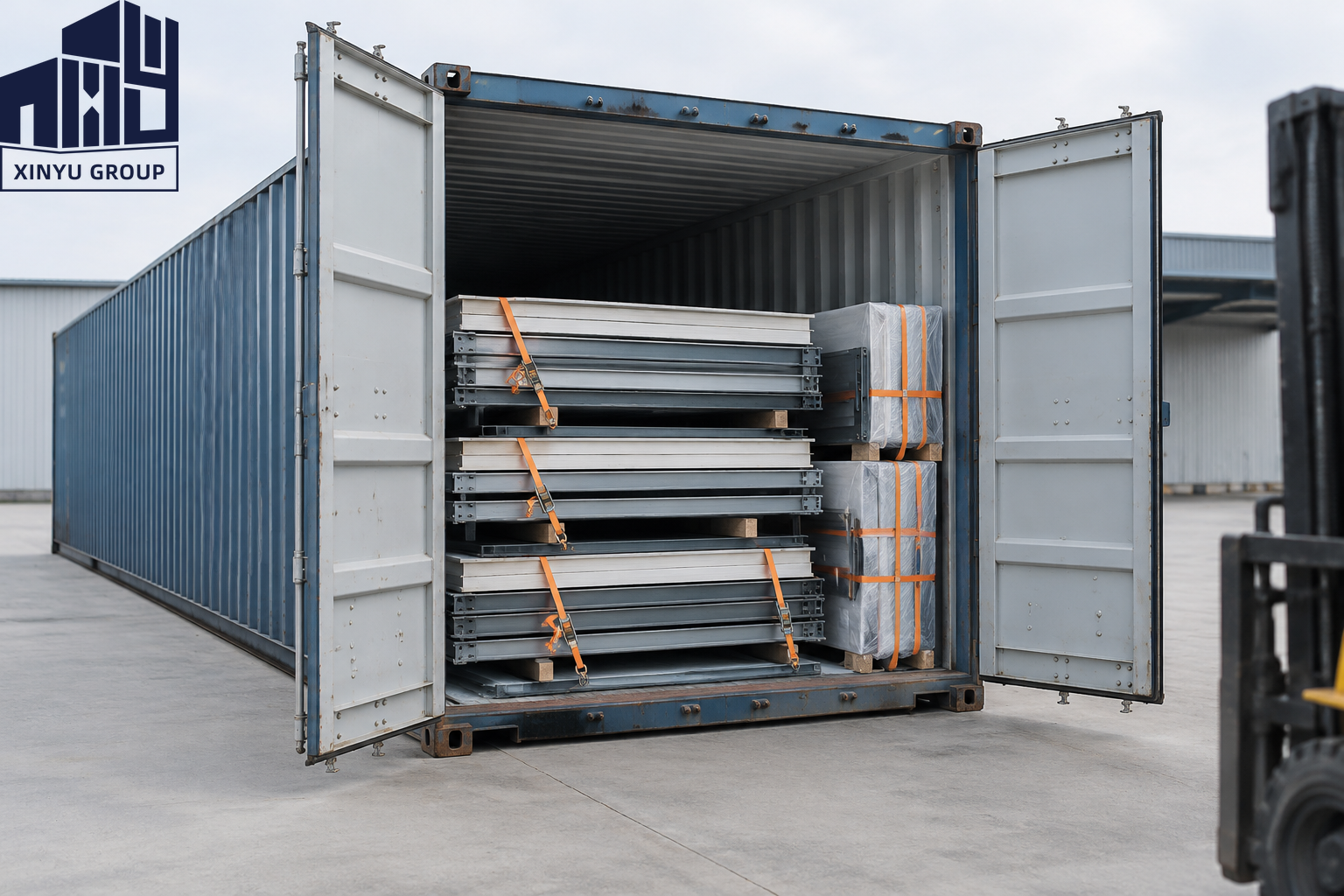
Short answer: a 40HQ holds roughly 10–12 folding container houses, 8 flat pack units, 15 detachable (fully disassembled) units, or 1–2 expandable houses, depending on how the unit is packed for transport. Those are reference values, not guarantees: the real number comes from three checks — usable volume (~76 m³), payload (~26,500 kg), and whether the packed module physically passes the 2,340 mm door opening. Because freight is charged per container and not per house, this single number is often the difference between a 250anda3,000 freight cost per unit.
Why the number varies by a factor of twelve
A container house is not one product with one shipping form. The same 20ft footprint can leave the factory as a finished volumetric unit, as a folded slab, as a flat-packed kit, or as a pile of panels and frame members. Each form wastes a different amount of the container's 76 m³.
That is the whole explanation for the table below. It is not that one supplier packs better than another; it is that a finished house is mostly air when it is inside a shipping container.
Reference loading quantities for a 40HQ
The figures below are the reference values published by modular housing exporters, cross-checked against a second supplier's published comparison. Treat them as a planning baseline and confirm the final count against your specific model, roof type, interior fit-out and accessory list.
Two patterns are worth memorising before you read a quotation:
- If the house arrives built, you are paying to ship air. An expandable 40ft unit occupies most of a 40HQ on its own. The trade-off is that it is habitable within hours of arrival — no assembly crew, no panel work, no site supervision.
- If the house arrives as parts, you are paying for assembly labour instead of freight. The detachable and quick-assembly forms fit 15–18 sets per container, roughly double the flat pack. What you save in freight you spend in on-site hours and in the risk of a slower first fix.
How to calculate the real number for your order
Do not rely on the table alone. Run these three checks — they take ten minutes and they prevent the most expensive mistake in container house procurement, which is discovering at the port that two units will not fit.
Check 1 — Volume
A 40HQ has an internal volume of about 76 m³. Divide by the packed volume of one unit:
Packed volume is not the same as finished volume. A 20ft flat pack unit that becomes a 14 m² room travels as a 5.8 m × 2.44 m × 0.6 m cassette — about 8.5 m³, which suggests roughly 9 units by raw volume. The container actually takes 8, because blocking, lashing and the last half-metre of unusable height eat the difference. That gap is exactly why you should ask your supplier for the packed dimensions, not the finished dimensions — and why the brochure cube figure is always slightly optimistic.
Check 2 — Payload
A 40HQ carries roughly 26,000–28,000 kg of cargo depending on the container and the carrier. Divide by the shipping weight of one unit:
Sandwich panel houses are light, so payload rarely binds for folding and flat pack units. It does bind for expandable houses with bathrooms, kitchens and tiling already installed — those are heavy, and two 20ft units can approach the payload limit before the cube is full.
Check 3 — Door aperture
This is the check buyers forget. A 40HQ door opening is approximately 2,340 mm wide × 2,585 mm high. A module that is 2,438 mm wide will not go through it, however much volume is left inside.
Before you confirm an order, ask your supplier for the packed module dimensions and compare them to the door aperture. If the packed unit is wider than the aperture, it ships on a flat rack, as break bulk, or not at all — and that changes the freight line on your quotation completely.
Take the lowest of the three
Allow that 5–10% deliberately. Timber blocking, corner protection, strapping and access clearance all consume cube that the brochure figure ignores.
What this actually costs you per house
Freight is quoted per container. The loading count is therefore a direct multiplier on your landed cost per unit.
Take a 40HQ at a hypothetical $3,000 door-to-port rate for the example only — your actual rate depends on the lane, the season and the carrier:
Read that table next to a price list and the procurement logic becomes obvious. On a 20-unit site camp, shipping expandable 20ft units needs ten containers; shipping folding units needs two. The freight difference on that single decision runs to five figures — which is usually more than the entire price gap between the two product types.
This is also why the answer to "which container house is cheaper" is not a price-list question. It is a shipped-cost question, and the loading count is half the calculation.
Five things that quietly cut your loading count
- A pitched or insulated roof. A thicker roof cassette adds height to every stacked unit and can cost you one or two sets per container.
- Bathroom pods and kitchen units shipped assembled. These do not nest. Ask for them flat-packed or packed inside the frame void.
- Oversized windows and doors shipped fitted. Fitted joinery protrudes and blocks stacking; separately crated joinery fills otherwise dead space.
- Mixed models in one container. Convenient for a small project, expensive for a large one — mixed loads leave unusable voids. Above roughly four containers, split by model.
- Accessories quoted separately and shipped loose. Air conditioners, water tanks and furniture are dense and awkward. Confirm whether they are inside the container count or on top of it.
What to ask your supplier before you book freight
Send these six questions with your enquiry. A supplier who answers all six quickly is a supplier who has actually loaded containers.
- What are thepackeddimensions and packed weight per unit — not the finished dimensions?
- How many units per 40HQ forthis specific configuration, including roof type and interior fit-out?
- Is the loading plan drawn to scale, and can you send the loading photos from a previous order of the same model?
- Are accessories, sanitary ware and kitchen units included in that count, or additional?
- What blocking, lashing and corner protection is included, and how much cube does it consume?
- Which port, and what is the typical handling time from factory gate to loaded container?
FAQ
How many container houses fit in a 40HQ? Reference values: 10–12 folding houses, 8 flat pack units, 15 fully disassembled detachable units, 18 quick-assembly sets, or 1–2 expandable houses. The figure depends on the shipping form and on your model's packed dimensions.
Why do expandable houses load so few per container? Because they ship as finished rooms. An expandable 40ft house is a complete dwelling folded into its own transport envelope, so it consumes most of the container on its own. You are trading freight cost for zero on-site assembly.
Is it cheaper to ship flat pack or folding container houses? Per unit of freight, folding usually wins slightly (10–12 versus 8 per 40HQ). Per unit of total project cost, it depends on assembly labour at destination and on how quickly you need the units usable. Model both, not just the freight line.
Can I mix different container house models in one 40HQ? Yes, and for small orders it is often the only practical option. For orders above roughly four containers, mixed loads waste cube at the voids between incompatible modules — splitting by model usually saves more than the extra container costs.
Does the 40HQ weight limit ever matter? Rarely for panel-based houses, which are light relative to their volume. It matters for expandable units shipped with bathrooms, kitchens and floor tiling installed, and for any order that includes dense accessories such as air conditioners or water tanks.
How much contingency should I allow for packing material? Five to ten percent of the cube. Blocking, lashing, corner protectors and loading clearance are real and are routinely left out of brochure loading figures.
What if my module is wider than the container door? It cannot be loaded through a standard 40HQ door opening of about 2,340 mm. In that case the unit ships on a flat rack or as break bulk, which changes both the freight cost and the port handling. Confirm packed dimensions against the aperture before you confirm the order.
Does the loading count change the delivery schedule? Yes. Fewer units per container means more containers, and more containers means more bookings, more cut-off dates and more chances of a rolled sailing. On a fixed site date, the loading count is a schedule variable, not just a cost variable.
Need Us to
Contact You?
We received your message and will contact you as soon as possible.
Thank you for your visit.