news
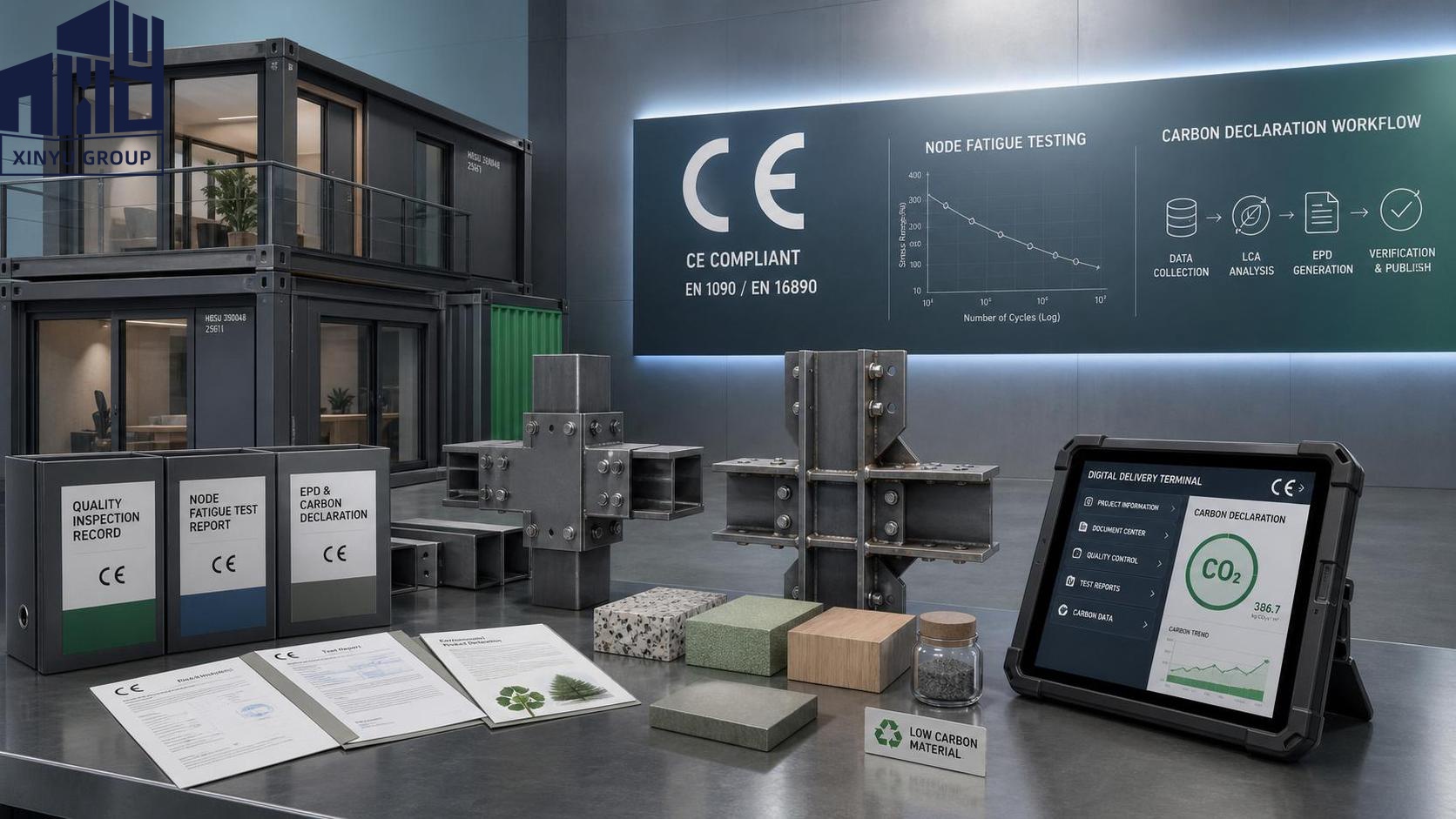
On June 25, 2026, the Official Journal of the European Union published a revised harmonized version of EN 1090-1:2023+A1:2026, immediately raising the compliance threshold for container house manufacturers targeting the EU market. The change is noteworthy not only for its new mandatory requirements on connection node fatigue performance in modular buildings, digital twin delivery documents, and carbon footprint declarations, but also for its short transition window: the new rules take effect on July 1, 2026, with only 30 days for adjustment. For manufacturers, exporters, certification teams, and supply-chain partners, the issue is no longer whether the standard matters, but whether current documentation, testing, and factory production control can still support a valid CE Declaration of Conformity.

What the revised standard now requires
According to the information provided, the OJEU published the updated harmonized standard EN 1090-1:2023+A1:2026 on June 25, 2026. The revision adds mandatory requirements covering three areas: fatigue performance of connection nodes in modular buildings, digital twin delivery documentation, and carbon footprint declarations.
The new requirements become effective on July 1, 2026, and the transition period is limited to 30 days. For container house manufacturers planning to export to the European Union, compliance now requires immediate updates to the FPC system, supplementary type testing, and submission of an EPD environmental product declaration. Without these steps, the CE Declaration of Conformity cannot be signed.
Where the pressure appears across the business chain
Export-facing manufacturers face the most direct compliance risk
From an industry perspective, the first and most immediate impact falls on manufacturers of container houses intended for EU export. The reason is clear: the revised standard directly affects the technical and documentary basis needed for CE marking. The pressure is likely to appear in product verification, internal quality control procedures, and readiness of technical files.
Testing and documentation functions become operational bottlenecks
Analysis shows that the new mandatory items do not only concern product design; they also affect the flow of evidence behind market access. Supplementary type testing, digital twin delivery documentation, and EPD submission all point to heavier demands on compliance documentation. For businesses, this means document completeness and timing may become just as critical as manufacturing itself.
Supply-chain and delivery coordination may need tighter alignment
Observably, suppliers, service providers, and delivery coordinators linked to EU-bound projects may also feel the impact, especially where project schedules depend on CE documentation being finalized on time. What deserves closer attention is whether product data, environmental declarations, and delivery files can be assembled without delaying shipment or contractual handover.
What companies should review right now
Whether the current FPC system still matches the new rule set
The immediate practical issue is whether an existing factory production control system already covers the newly mandatory requirements. Companies with EU export plans need to check if their current procedures, records, and control points can support the updated standard rather than the previous basis used for CE compliance.
Whether supplementary testing can be completed in time
The 30-day transition period leaves little room for a phased response. Analysis shows that manufacturers should pay close attention to whether supplementary type testing related to the revised requirements has been initiated, updated, or scheduled in a way that supports continued export planning.
Whether digital and environmental documents are treated as core compliance files
The inclusion of digital twin delivery documents and carbon footprint declarations indicates that technical conformity is now tied more closely to structured data delivery and environmental disclosure. For companies, the key point is not to treat these as secondary paperwork, but as documents that may directly affect the ability to complete CE conformity documentation.
Whether customer and partner communication needs immediate revision
Where projects are already in quotation, production, or delivery preparation for the EU market, companies should review how they communicate timelines, document status, and compliance conditions with buyers and service partners. The policy signal is already clear, but the practical landing point depends on how quickly each business can align internal files and external commitments.
Why this looks like more than a short-lived procedural update
As an editorial observation, this development is better understood as an immediate compliance change with longer-term signaling value. The immediate part is straightforward: from July 1, 2026, manufacturers seeking CE marking for container houses exported to the EU must work under the revised standard. The longer-term signal, based on the information provided, is that structural performance verification, digital delivery documentation, and carbon-related disclosure are appearing together within the same compliance framework.
At the same time, it would be premature to extend this into broader claims beyond the provided facts. Observably, the current information confirms a rule change and a short transition period, but further interpretation about wider market outcomes still requires continued verification through subsequent official wording and implementation practice.
How the market should read this update now
At this stage, it is more appropriate to understand the update as a near-term execution issue with strategic implications rather than as a routine standards revision. The confirmed facts already show a direct effect on CE conformity work for EU-bound container houses. For the industry, the main significance lies in the narrowing gap between technical testing, digital documentation, and environmental disclosure in market access procedures.
A neutral reading is that the compliance threshold has become more integrated and more time-sensitive. The most important current task for affected businesses is therefore not broad speculation, but immediate verification of whether their FPC, testing status, and EPD-related documentation can support uninterrupted EU export activity.
Basis of this article and points for continued verification
This article is based on the user-provided news title, event date, and event summary concerning the EU update to EN 1090-1:2023+A1:2026 and its application to container house CE certification. Information of this type is commonly cross-checked against official notices, company announcements, industry association updates, authoritative media reports, and standard-related documents.
No specific official source link was provided in the input, so the exact official link still needs to be continuously verified. For follow-up observation, the most relevant points are any further official clarification on implementation wording, practical treatment of the 30-day transition period, and how affected companies document FPC updates, supplementary type testing, and EPD submissions in actual CE conformity workflows.
Need Us to
Contact You?
We received your message and will contact you as soon as possible.
Thank you for your visit.