news

From October 1, 2026, container housing imported into the EU falls under a clearer and stricter compliance threshold after EN 16893:2026 was brought into effect within the CPR framework. The update matters not only to modular steel building manufacturers, but also to importers, distributors, project bidders, and supply chain service providers, because market access now depends more directly on whether the required DoP documentation and third-party type testing are in place.
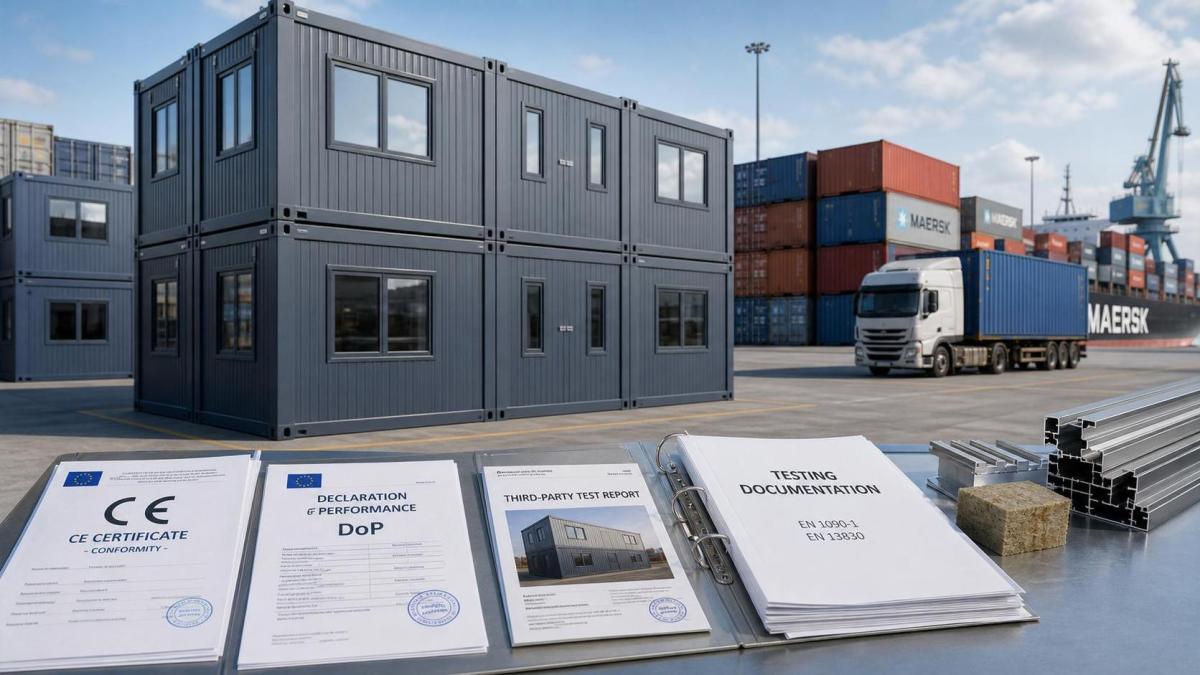
What the standard now requires
According to the information provided, the Official Journal of the European Union (OJEU) published the revised CPR supporting standard EN 16893:2026 on July 15, 2026. The standard explicitly brings modular steel buildings, including container houses, into the scope of mandatory CE certification.
Starting on October 1, 2026, all container houses imported into the EU must provide a Declaration of Performance (DoP) compliant with this standard as well as a third-party type inspection report. The new requirements place stronger emphasis on fire performance at the B-s1,d0 level, structural load verification, and declarations related to circular materials.
Where the pressure will be felt first
Import and customs-facing businesses
From an industry perspective, importers are among the first parties likely to feel the operational impact because the rule is tied directly to products entering the EU market. The most immediate points of attention are customs clearance documentation, proof readiness before shipment, and whether product files align with EN 16893:2026 rather than older assumptions about container-based structures.
Manufacturers of modular steel buildings
For manufacturers, the issue is not only product design but also evidence. Analysis shows that fire classification, structural load validation, and circular material declarations may affect technical documentation, testing arrangements, and how export-ready models are presented to EU customers. The practical impact is likely to appear in certification preparation, specification review, and delivery timing.
Distributors and channel partners
Distributors may be affected because sales continuity depends on whether imported units can be lawfully placed on the market and supported in tenders. What deserves closer attention is the handoff between manufacturer files and distributor-facing compliance records, especially where sales teams are expected to answer buyer questions about CE status, DoP availability, and third-party verification.
Project owners and bidders
The provided information also indicates direct relevance to project bidding. For procurement teams and bidders, the change may affect supplier screening, bid eligibility review, and the acceptability of proposed container housing products in projects that require formal proof of compliance. In this context, documentation completeness becomes part of commercial competitiveness, not just regulatory formality.
What companies should check now
Whether current products fall within the clarified scope
Companies dealing in modular steel structures and container houses should first confirm whether the products they export, import, distribute, or specify are covered by the clarified mandatory CE route under EN 16893:2026. This is a practical classification issue, especially where products may previously have been treated under narrower or less explicit assumptions.
Whether supporting documents are ready before shipment or tender
Observably, the requirement is not limited to a label or a general claim of conformity. The stated need for a compliant DoP and a third-party type inspection report means businesses should pay attention to document completeness, consistency between technical files and commercial materials, and whether the same evidence can support both customs processes and project submissions.
How fire, load, and circular material claims are evidenced
The rule highlights three areas that deserve closer attention: B-s1,d0 fire performance, structural load verification, and circular material declarations. Companies should distinguish between internal product claims and the level of substantiation needed for external review, particularly where customers, distributors, or authorities may ask for formal evidence rather than general specifications.
How supplier and customer communication needs to change
Analysis shows that this is also a communication issue across the chain. Exporters may need clearer requests to upstream suppliers for testing and declaration support, while importers and distributors may need earlier discussions with EU customers about compliance timing, bid documents, and possible delivery risks if files are incomplete.
Why this looks like more than a short-term paperwork change
It is more appropriate to understand this as both an immediate market-entry requirement and a longer-term regulatory signal. The immediate result is clear: from October 1, 2026, imported container housing for the EU market must meet the stated documentation and certification expectations. Analysis shows the broader signal lies in how modular steel buildings are being treated more explicitly within the CPR-related compliance framework, with stronger focus on verified fire performance, structural proof, and circular material disclosure.
At the same time, this should not be overstated beyond the provided facts. The information confirms the compliance trigger and the areas of emphasis, but further operational interpretation may still depend on how businesses, buyers, and market authorities apply the standard in real transactions, tenders, and product reviews.
How the market is likely to read this update
For the industry, the significance of this development is not simply that a new standard exists, but that container housing entering the EU now faces a more explicit compliance threshold tied to CE access conditions. A neutral reading is that this is already a concrete rule change for trade and project participation, while also serving as a longer-term signal that technical substantiation in modular construction is becoming more central to market access.
Current attention is best placed on documentation readiness, testing support, and coordination between manufacturing, import, and bid-facing teams. That is a more grounded interpretation than treating the update as either a routine procedural adjustment or a fully settled endpoint.
Basis of this article
This article is based on the user-provided news title, event date, and event summary regarding EN 16893:2026, the OJEU publication date of July 15, 2026, and the effective date of October 1, 2026.
For this type of industry update, source categories commonly relevant include official notices, standard-related documents, industry association materials, company disclosures, and reporting by authoritative trade or policy media. A specific official source link was not provided in the input, so the exact linked source still requires ongoing verification. Follow-up attention should remain on any further official wording, interpretive guidance, and practical implementation details affecting customs clearance, distribution, and project bidding.
Need Us to
Contact You?
We received your message and will contact you as soon as possible.
Thank you for your visit.