news

On June 26, 2026, U.S. Customs and Border Protection (CBP) issued an emergency memorandum that changes the import documentation threshold for prefabricated steel building products entering the U.S. as modular buildings, movable housing, or container housing. From July 1, 2026, these products must be accompanied by a certified Full Supply Chain Compliance Statement, a change that matters directly to exporters, procurement teams, manufacturers, testing and certification participants, and customs-facing supply chain operators because it can affect both customs clearance timing and market access.
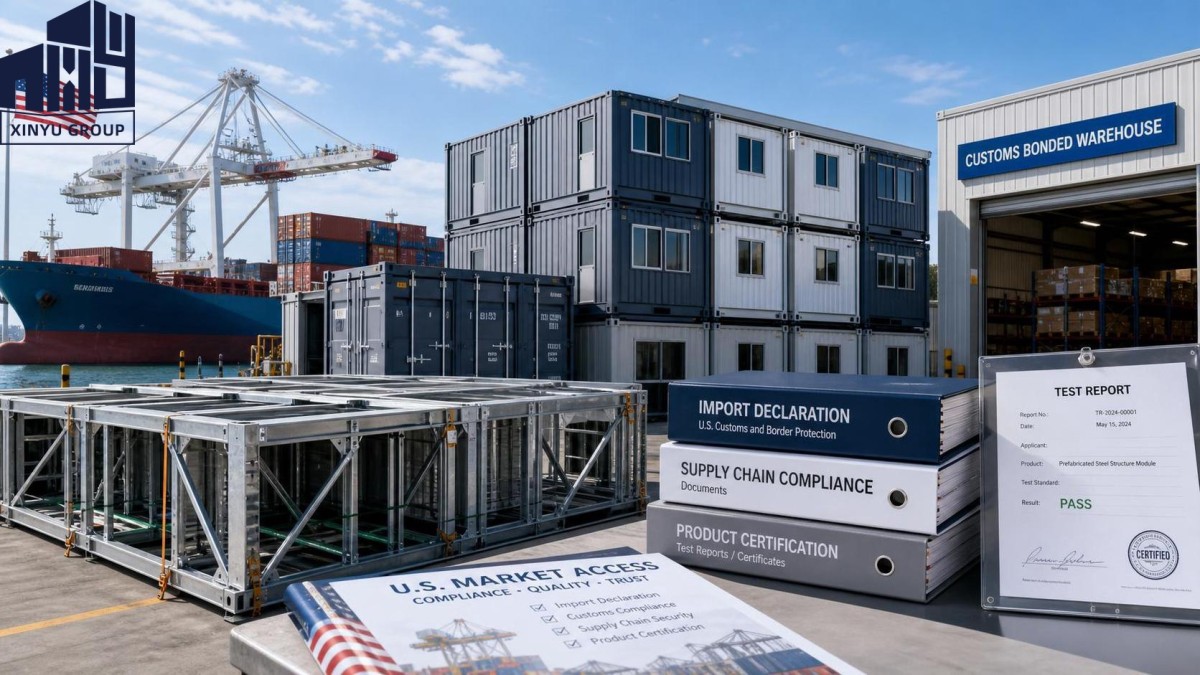
What the new filing requirement now includes
According to the information provided, CBP released Emergency Memorandum CBP Directive No. 3510-026 on June 26, 2026. The memorandum requires that, starting July 1, 2026, all imported prefabricated steel structure building products entering the United States in the form of modular buildings, movable houses, or container houses must be submitted with a certified Full Supply Chain Compliance Statement.
The required statement must cover raw material origin, certification related to welding and anti-corrosion processes, fire performance test reports, and proof that the final assembly plant holds both ISO 9001 and ISO 14001 systems. The information provided also states that this requirement directly affects customs clearance timeliness and market access eligibility for Chinese exporters.
Where the pressure is likely to appear first
Export-facing suppliers may face a higher document threshold before shipment
From an industry perspective, exporters of container housing and other covered prefabricated steel structure products are likely to be the first group affected because the new requirement is tied directly to import entry into the U.S. The practical pressure point is not only product shipment, but whether the full compliance file can be assembled in a certified form before customs processing. What deserves closer attention is the completeness and consistency of origin records, process certifications, fire test documentation, and assembly plant system certificates.
Manufacturing and assembly links will be pulled into customs compliance
Analysis shows that the rule change connects factory-side production evidence more closely to import clearance. Manufacturers and final assembly plants involved in covered products may need to pay closer attention to whether welding, anti-corrosion, fire performance, and management system documentation can be presented in a way that supports the required statement. This shifts part of the compliance burden from a narrow trade filing task to a broader factory-to-customs documentation chain.
Procurement and upstream sourcing may come under closer review
Observably, the inclusion of raw material origin in the required statement means procurement and sourcing functions may also be affected. For businesses selling into the U.S. market, supplier selection, purchase records, and traceability arrangements may become more relevant to shipment readiness than before. The immediate issue is less about commercial pricing and more about whether upstream materials can be linked to a compliant import file.
Testing, certification, and logistics support providers may see tighter coordination demands
Supply chain service providers, including testing, certification, and customs-related operators, may be affected because the rule introduces a more document-intensive clearance path. Their role may increasingly depend on how quickly supporting reports and system certificates can be checked, organized, and aligned with shipment documents. Analysis shows that coordination risk may rise where product files are fragmented across multiple suppliers or production sites.
What companies should monitor from this point
Check whether existing files can support the required statement
Companies involved in affected exports should pay close attention to whether current documentation already covers all four named elements in the provided summary: raw material origin, welding and anti-corrosion process certification, fire performance testing, and ISO 9001 plus ISO 14001 proof for the final assembly plant. Where documents exist but are scattered across vendors or factories, file readiness may become a practical issue.
Review shipment timing against the July 1 effective date
Because the memorandum was issued on June 26, 2026 and the requirement applies from July 1, 2026, the transition window described in the input is short. It is more appropriate to understand this as an immediate compliance trigger rather than a distant policy signal. Companies with products moving toward U.S. import procedures should closely watch how document preparation affects dispatch, filing, and delivery schedules.
Watch for execution language and document handling practice
Analysis shows that the current information confirms the existence of the requirement, but does not provide fuller operational detail on documentary format, review method, or handling standards beyond the summary provided. For that reason, businesses should continue to monitor subsequent official wording, customs practice, and any downstream changes in buyer documentation requests, tender materials, or import filing expectations.
Focus on traceability and after-delivery risk exposure
For suppliers serving the U.S. market, the compliance issue is not limited to the point of customs filing. Observably, a requirement built around end-to-end statements can also increase attention on traceability, supporting reports, and the internal consistency of technical and quality records. Businesses should therefore pay attention to how export files, product records, and supplier qualifications are retained and matched across the delivery chain.
How this change is best interpreted right now
Analysis shows that this development is better understood as a concrete execution signal than as a general policy discussion. The effective date is specified, the covered product forms are identified, and the required compliance statement includes named documentation elements. At the same time, the input does not provide broader enforcement detail, market response, or case-level implementation outcomes. That means the rule appears to be operational in direction, while some execution nuances still require observation.
From an industry perspective, the most important point is that customs compliance for covered prefabricated steel structure products is being tied more explicitly to upstream sourcing evidence, process certification, product testing, and plant management systems. That changes the center of attention from a single customs filing event to the quality of the supporting compliance chain behind it.
What deserves the closest takeaway
This update should be read as a near-term compliance change for container housing and related prefabricated steel structure products entering the U.S., especially for Chinese exporters whose clearance timing and eligibility may be affected. It does not yet justify broad conclusions beyond the facts provided, but it clearly raises the importance of document readiness, traceability, and coordination across procurement, manufacturing, certification, and export filing. At this stage, it is more appropriate to understand the development as an implemented rule signal with follow-through details still worth watching.
Basis of this article and points still to verify
This article is based on the user-provided news title, event date, and event summary. For events of this type, relevant source categories commonly include official notices, releases from regulatory authorities, customs or trade administration information, industry association updates, standard-setting documents, and reporting by authoritative media. A specific official source link was not provided in the input, so that point still requires ongoing verification.
Observably, the areas that still warrant follow-up include any further policy detail, certification interpretation in practice, customs execution language, changes in buyer or tender documentation, industry feedback, and how affected companies implement the requirement in actual export and delivery workflows.
Need Us to
Contact You?
We received your message and will contact you as soon as possible.
Thank you for your visit.